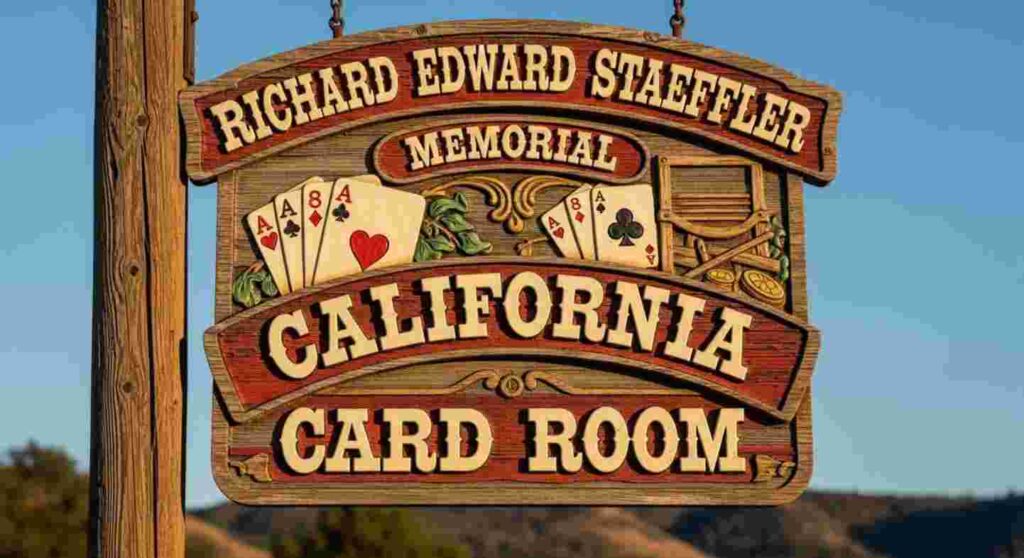

The Richard Edward Staeffler Memorial California Card Room: A Deep Dive into Gaming History
Introduction: A Name Etched into the Chips of Time
What is the Richard Edward Staeffler Memorial California Card Room—Who was Richard Edward Staeffler? And why is his name immortalized in what sounds like a casino—yet isn’t a casino at all? For those steeped in the world of gambling lore, especially California’s mid-century card rooms, the term Richard Edward Staeffler Memorial California Card Room strikes a different chord. It’s not neon signs and felt tables—but something arguably more enduring: a paper trail of poker history.
So, what is the Richard Edward Staeffler Memorial California Card Room? At its core, it’s a tribute to a man who made it his life’s work to preserve the stories of the state’s gambling dens—past and forgotten. This article will guide you through the life of Richard Edward Staeffler, decode the memorial bearing his name, and explore its broader importance in the story of California’s card rooms. If you’re a collector, a gambling historian, or simply someone captivated by the analog treasures of a bygone era, this is the deep dive you’ve been looking for.
Who Was Richard Edward Staeffler?
To understand the memorial, you must first understand the man. Richard Edward Staeffler wasn’t a high-rolling poker player, nor a flamboyant casino owner. His value came from a quieter place—one built on meticulous research, field interviews, chip trades, and stacks of forgotten records. He was, in every sense of the word, a historian of California card rooms.
Born in the mid-20th century, Staeffler developed an affinity for gambling memorabilia, particularly items from the card rooms that dotted California from the 1930s through the 1980s. But his passion wasn’t just rooted in collecting. It was archival. He realized early on that these rooms—unlike the glitzy casinos of Las Vegas—were under-documented. They often existed in legal gray zones, especially before state regulation normalized the industry.
Through years of boots-on-the-ground research, Staeffler traveled up and down the California coast, recording the names, addresses, operating years, and associated paraphernalia of hundreds of card rooms. He interviewed former dealers and owners. He compared chips based on weight, manufacturer, and edge spots. His eye for detail was forensic. And for many collectors today, his work is still the gold standard.
For those who spent countless hours poring over his guides, Richard Edward Staeffler was more than a name—he was the gatekeeper to a forgotten era. A man who realized that without documentation, history becomes hearsay. The memorial created in his name is not just a nod of respect; it’s a vault of knowledge.
Deconstructing the “Memorial” and the “Card Room”
Let’s dispel the most common misunderstanding right away: The Richard Edward Staeffler Memorial California Card Room is not a physical card room. You won’t find it on a Google Map, and it’s not housed inside any building with blackjack tables and drink service.
Instead, it’s a memorial in the form of a comprehensive reference guide—a master index, if you will, of California’s historical card rooms. This “card room” is metaphorical, built not with walls and slot machines, but with pages and cataloged chips.
The guide—often referred to as the Staeffler Memorial by collectors—is believed to have been compiled and expanded upon by fellow historians and enthusiasts after Staeffler’s passing. It documents card rooms by city and county, detailing everything from opening and closing dates to chip designs and table games offered.
One example: A listing for the long-defunct “Lucky Lady Card Room” in Modesto includes images of its rare yellow clay chip with a black edge insert, its years of operation (1967–1974), and an anecdote about the owner who allegedly dealt Texas Hold’em before it became mainstream.
Another entry—**”Gardena Club”—**includes not only its iconic white chip with red hot stamp, but also a summary of how Gardena once held the title of poker capital of the world before state regulations shifted the power northward.
This memorial, then, serves as a Rosetta Stone for California gaming memorabilia. It connects the dots between scattered historical fragments, transforming them into a cohesive narrative. For collectors, it means the difference between a chip worth $10 and one worth $1,000. For researchers, it’s a treasure trove.
The Golden Age of California Card Rooms
To appreciate the depth of Staeffler’s work, you need to understand the world he sought to preserve.
California’s relationship with gambling has always been complicated. While Las Vegas casinos operated under one regulatory framework, California allowed card rooms—venues that could offer poker and certain other games, provided the house didn’t bank the game. This legal loophole created a flourishing industry unique to the state.
The golden age of California card rooms roughly spanned the 1940s to the early 1980s, with towns like Gardena, Bell Gardens, and San Jose becoming hotbeds of poker culture. At one point, Gardena alone had six licensed card rooms within a square mile—each one humming with the slap of chips and low-stakes banter.
The social dynamic was distinct. These weren’t casinos packed with tourists. They were community hubs, often frequented by locals, retirees, and working-class folks who’d finish their shift and sit down to a game of draw poker or lowball.
One dealer from the era, interviewed in a now-defunct poker zine, recalled how “you knew every face at your table. There was Joe from the bakery, Maria who ran the flower shop, and Big Al who always brought cigars but never smoked them.” [Link to archived zine]
The decor was rarely flashy—fluorescent lights, worn carpet, and the scent of strong coffee. But for many, that was part of the charm. These rooms weren’t about escapism. They were about presence.
It’s this authenticity—the unvarnished reality of California’s gaming scene—that Staeffler sought to immortalize. And in doing so, he captured a slice of Americana that the glitz of Vegas never quite touched.
The Lasting Influence on Gaming Collectibles
Among serious casino memorabilia collectors, Staeffler’s influence is both foundational and ongoing. Before his documentation, many collectible items—especially poker chips, matchbooks, ashtrays, and felt cutouts—had ambiguous origins. His guide offered something that had been sorely lacking: provenance.
Take, for instance, the case of a red $1 chip stamped “El Prado.” For years, collectors debated whether it came from a card room in Riverside or a short-lived operation in East LA. Through Staeffler’s meticulous notes and matching details from local permit records, it was definitively traced to a 1960s club in Montebello, dramatically increasing its historical—and market—value.
His guide also introduced a standardized classification system, organizing chips by region, color scheme, material (clay, plastic, ceramic), and known usage dates. This system has been adopted by leading chip catalogs, collector forums, and even online marketplaces.
Staeffler’s work laid the groundwork for other researchers. Publications such as The California Card Room Compendium and Collectors Weekly’s West Coast Chip Guide openly cite his original index as a core source. His ripple effect is evident in every verified chip listing and every reference photo passed between enthusiasts.
In this way, his legacy isn’t static—it evolves with every new collector who enters the field and picks up where he left off.
Preserving the Past in the Digital Age
Today, the legacy of Richard Edward Staeffler and his memorial guide lives on—digitally, communally, and passionately.
Online forums like ChipGuide.com, Casino Collectibles Association (CCA), and various Facebook collector groups continue to scan, debate, and build upon his work. Some even refer to entries as being “Staeffler-verified,” a nod to the enduring trust in his research. [Link to ChipGuide entry]
There’s also an emerging generation of digital archivists who are scanning and OCR-indexing the original pages of the memorial for posterity. Projects like the California Card Room Digital Archive Initiative (an independent effort by volunteers) aim to make the guide accessible and searchable, especially as physical copies become scarce.
But preserving history comes with challenges. As older collectors age out of the hobby, or records decay, the threat of data loss looms. That’s why enthusiasts stress the importance of contribution—scanning your chips, sharing old photos, or posting stories that once lived only in memory.
And then there’s the emotional side. One collector summed it up during a panel at the 2023 CCA convention:
“This hobby isn’t just about stuff. It’s about remembering people like Richard. He didn’t just collect chips. He collected moments. And that’s what we carry forward.” [Link to CCA convention panel summary]
Final Thoughts: More Than Just a Name
So, what is the Richard Edward Staeffler Memorial California Card Room?
It’s a love letter to a nearly forgotten world. A guidebook through poker’s past. A record of places that once buzzed with the shuffle of cards and the murmur of locals killing time.
But above all, it’s the legacy of a man who saw value in documenting what others overlooked. His memorial guide isn’t just a listing of card rooms. It’s a testament to the power of preservation—a reminder that even the smallest chip can hold a story.
For collectors, historians, and card room romantics alike, this guide remains a keystone—a bridge to California’s rich, off-the-record gambling history.
And that’s why the question “What is the Richard Edward Staeffler Memorial California Card Room?” deserves not just an answer—but a standing ovation.