
Trump’s 2025 H-1B Policy Shock: $100,000 Fees & The End of the Lottery System
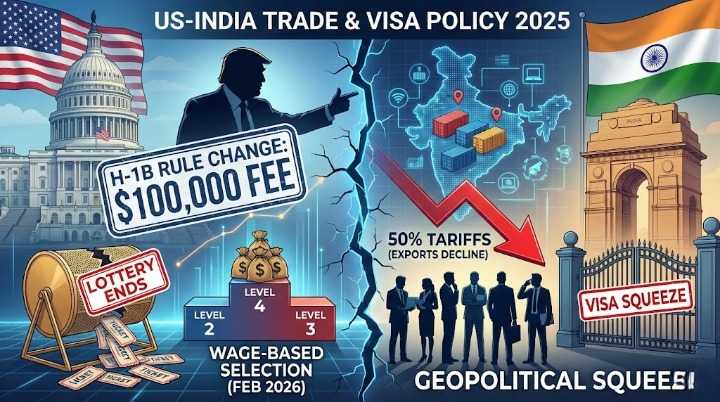
In a dual policy strike that has sent shockwaves from Silicon Valley to Bengaluru, the Trump administration has finalized two transformative measures: a lawful $100,000 entry fee for new petitions and a wage-based weighted selection model taking effect on February 27, 2026.1
This isn’t just a fee hike; it is a fundamental restructuring of the US-India talent corridor. Compounded by the new 50% trade tariffs on Indian exports, we are witnessing the most aggressive “Geopolitical Squeeze” on Indian IT in history.
If you are a recruiter, an H-1B hopeful, or an investor, here is your survival guide to the new rules of 2026.
I. The $100,000 H-1B Fee: Who Pays and Who is Exempt?
On September 19, 2025, President Trump issued a Proclamation requiring a $100,000 payment for new H-1B petitions.2 While the U.S. Chamber of Commerce immediately sued, Judge Beryl Howell of the U.S. District Court ruled on December 23, 2025, that the President acted within his statutory authority to “restrict entry.”3
This means the fee is now the law of the land. However, confusion remains about who actually cuts the check.
The “New Petition” Rule
The $100,000 fee applies strictly to new H-1B petitions filed for beneficiaries currently outside the United States.4
-
Renewals & Extensions: Exempt.5 If you are already in the US on an H-1B, your extension does not cost $100k.6
-
Change of Status (F-1 to H-1B): This is the critical loophole.7 If a student is already in the US on an F-1 visa and changes status to H-1B, the fee generally does not apply—unless they travel internationally and need a new visa stamp to re-enter.
The “National Interest” Exception (NIE)
The Proclamation allows for exceptions if the role is in the “National Interest.”8 However, data from October to December 2025 shows a denial rate of over 92% for these requests. Unless you are working on direct Department of Defense (DoD) contracts or critical AI safety research, do not budget on getting this waiver.
From the Recruiter’s Desk: The “Pay.gov Trap”
“We’ve seen three clients lose $100,000 this month because they didn’t read the fine print. The fee must be paid via Pay.gov before you file the I-129.9 Here is the kicker: If USCIS denies your petition because you selected the wrong SOC code or missed a document, the $100,000 is non-refundable.10 Treat that payment receipt like gold dust—and triple-check your eligibility before you click ‘Submit’.”
II. Farewell Lottery, Hello Wage Levels: How the 2026 Selection Works
While the fee grabs headlines, the DHS Final Rule published on December 23 is the real game-changer.11 Effective February 27, 2026, for the FY 2027 cap, the random lottery is replaced by a Weighted Selection Model.12
The new system incentivizes higher salaries by giving more “entries” (lottery tickets) to higher wage levels.13
The Math of Weighted Selection
Under the Department of Labor (DOL) wage tiers, your “luck” is now mathematically determined by your salary offer:
| DOL Wage Level | Description | Selection Weight (Entries) | Probability Impact |
| Level 4 | Fully Competent / Senior | 4x Entries | Highest Chance (Near Guarantee) |
| Level 3 | Experienced | 3x Entries | High Chance |
| Level 2 | Qualified | 2x Entries | Moderate Chance |
| Level 1 | Entry Level | 1x Entry | Dead Zone ( < 10% chance) |
Impact on Indian IT Giants
For decades, companies like TCS, Infosys, and Wipro relied on flooding the lottery with Level 1 and Level 2 candidates. This model effectively kills that strategy. A Level 1 junior developer now has one-fourth the chance of being selected compared to a Level 4 senior architect.
This forces a massive shift: Onshoring. Expect Indian consultancy firms to hire more local US graduates for junior roles while reserving H-1B sponsorship only for high-billing senior consultants.
III. The Geopolitical Squeeze: Why India is in the Crosshairs
You cannot view these visa changes in a vacuum. They are part of a broader trade war.
In late 2025, the US Trade Representative (USTR) imposed a 50% tariff on Indian goods.14 The trigger? India’s refusal to stop purchasing Russian oil, which the US claims is undermining Western sanctions.15
The “Russian Oil” Connection
The US-India relationship is currently transactional. The 50% tariff (25% reciprocal + 25% penalty) has already caused a 28.5% drop in Indian exports to the US in Q4 2025.
This creates a “double squeeze” for Indian professionals:
-
Corporate squeeze: Tariffs reduce the profit margins of Indian export companies.
-
Talent squeeze: The $100k visa fee makes it too expensive to move staff to the US to fix the problem.16
This is a calculated move to force New Delhi’s hand on BRICS alignment. The message from the White House is clear: Access to the US market (and labor market) is a privilege, not a right.
IV. Strategic Pivots for 2026: Recruiting & Career Moves
The door isn’t closed, but the lock has changed. Here is how smart teams are pivoting for the February 2026 filing season.
For Recruiters: The “SOC Code” Strategy
To survive the Weighted Selection, you must get your candidate to Level 3 or 4.
-
The Mistake: Filing a “Software Developer” (generic) role in San Francisco. The Level 4 wage is over $180,000.
-
The Strategy: Reclassify the role. Instead of “Software Developer,” can the role be classified as a “Computer Systems Analyst” or “Database Architect”?
-
Warning: The job duties must match. USCIS will issue an RFE (Request for Evidence) if you pick a lower-paying SOC code just to hit Level 4. But legitimate reclassification is the single most effective tool you have right now.
For Professionals: The L-1A and EB-5 Lifeboats
With H-1B becoming a “pay-to-play” system for the elite, other visa classes are seeing a resurgence:
-
L-1A (Intracompany Transferee): No cap, no lottery, and no $100k fee (yet). If you are a manager in India, push for a transfer rather than a new H-1B.
-
EB-5 (Investor Visa): With the H-1B fee effectively costing a company $100k, the $800k investment for an EB-5 Green Card suddenly looks like a comparable ROI for wealthy families planning long-term migration.
V. Conclusion: Navigating the Most Restrictive Era
The “American Dream” for Indian tech talent hasn’t disappeared, but it has become significantly more expensive and meritocratic.
The days of mass-applying for entry-level roles are over. The February 27, 2026 implementation of wage-based selection means that skill is the only currency that matters. If you are a Level 4 talent, your odds just improved drastically.17 If you are Level 1, the US door is effectively shut.
Final Insight:
Despite the rhetoric, the US tech sector needs Indian talent. The 2026 demand for AI specialists exceeds domestic supply by 40%. The fees and rules will filter out the “body shops,” but the true “specialty occupation” experts will always find a way in.
Next Step:
Don’t guess your odds. Download our “2026 H-1B Cost & Probability Calculator” to model your specific wage level and fee exposure before the February registration window opens.
FAQs
1. Does the $100,000 H-1B fee apply to renewals?
No. The September 19 Proclamation specifically applies to new petitions for beneficiaries outside the United States.18 Extensions and amendments for workers already in the US are currently exempt.19+1
2. When does the wage-based H-1B selection start?
The DHS Final Rule is effective February 27, 2026.20 This means it will govern the FY 2027 H-1B cap registration period that opens in March 2026.21+1
3. Is there a way to avoid the $100k H-1B fee?
The primary method is “Change of Status.” If a candidate is already in the US (e.g., on an F-1 student visa), the fee generally does not apply.22 However, if they leave the US and need a visa stamp to re-enter, they may trigger the fee at the consulate.23+1
4. How do the new US tariffs impact Indian jewelry and textiles?
Since August 2025, a 50% total duty (25% reciprocal + 25% penalty) has been applied to various Indian exports.24 This has led to a significant slowdown in orders from US retailers for Indian textiles and gems.
5. What are the 4 H-1B wage levels for 2026?
The levels are based on the Department of Labor’s OES survey.25 Level 1 is “Entry Level,” Level 2 is “Qualified,” Level 3 is “Experienced,” and Level 4 is “Fully Competent.”26 Under the new rule, Level 4 gets 4 lottery entries, while Level 1 gets only 1.27+2
6. Will Indian students in the US be affected by the $100k fee?
Directly, no, if they change status from F-1 to H-1B within the US. However, fewer employers may be willing to sponsor them if they fear the student might need to travel abroad, potentially triggering the fee upon return.
7. Why is Trump imposing 50% tariffs on India?
The administration cites India’s continued purchase of Russian oil and alignment with BRICS “de-dollarization” efforts as the primary drivers for the Section 301 investigation and subsequent tariffs