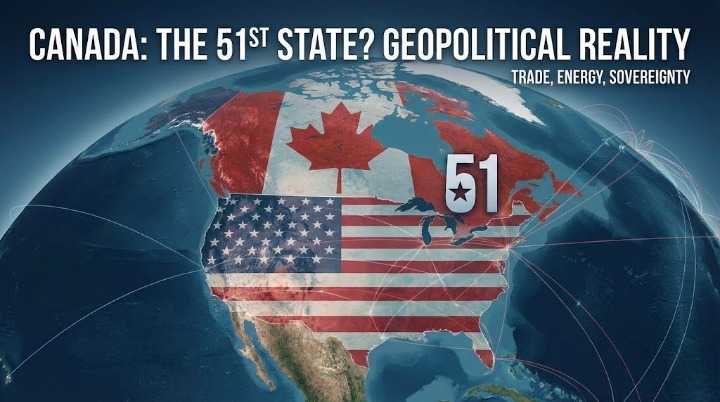

Canada as the 51st State: Pipe Dream or the 2025 Geopolitical Reality?
The border between the United States and Canada has long been called the longest undefended border in the world. But in late 2025, that definition feels outdated. Following the recent trade standoffs and the viral “51st State” proposals circulating in Washington, the conversation has shifted. We are no longer just joking about a Canada 51st state scenario. We are watching economic pressure test the very concept of Canadian sovereignty.
For decades, the idea of annexation was relegated to satire or fringe conspiracy theories. Today, it is a serious talking point in geopolitical strategy rooms. With the “border thickening” to levels not seen since 1812 and trade tensions hitting a breaking point, Americans and Canadians alike are asking the same question: Is a political merger inevitable?
This analysis cuts through the noise. We will look at the hard economic data, the constitutional mechanisms, and the real political hurdles that stand between the status quo and a unified North American super-state.
The 2025 Trade War: Annexation by “Economic Coercion”?
The rhetoric changed the moment the 35% tariff escalation hit in August 2025. This wasn’t just a standard trade dispute. It was a stress test for the Canadian economy.
When Washington signaled that the USMCA (United States-Mexico-Canada Agreement) might be subject to a “sovereignty surcharge,” it exposed a critical vulnerability. Canada sends over 75% of its exports to the United States. [ Statistics Canada 2025 Trade Report]. The economic reality is simple: Canada needs the US market to survive, but the US views Canadian resources as a matter of national security.
The Carney-Trump Standoff
The dynamic shifted significantly with the leadership changes in Ottawa. The relationship between Canadian officials and the US administration has moved from diplomatic politeness to transactional hardball.
Analyst Insight:
Watching the Mar-a-Lago transcripts from late 2025, you notice a specific change in language. American negotiators stopped asking for “fair trade” and started demanding “resource integration.” This suggests the “51st state” talk isn’t about adding a star to the flag. It is a negotiation lever. The threat of absorption is being used to force Canada into a customs union where they follow US rules without having a vote in US Congress.
This “economic coercion” effectively creates a state of annexation in everything but name. If Ottawa cannot set its own trade policy without facing crushing tariffs, the functional independence of the country is already compromised.
The Legal “How-To”: Article IV and the US Constitution
Let’s move from politics to legality. Suppose the political will existed. Could Canada 51st state actually happen legally?
The mechanism exists, but it is not as simple as signing a treaty. We have to look at Article IV, Section 3, Clause 1 of the US Constitution, often known as the Admissions Clause.
The Constitution states:
“New States may be admitted by the Congress into this Union; but no new State shall be formed or erected within the Jurisdiction of any other State… without the Consent of the Legislatures of the States concerned as well as of the Congress.”
This grants Congress the power to admit Canada. However, the structure of that admission is the real hurdle.
The “Puerto Rico Model”
Most people assume Canada would instantly become states equal to New York or California. That is unlikely. The more probable first step is the “Puerto Rico Model.”
Under this scenario, Canada (or specific provinces) would first become an incorporated territory. This allows the US to secure resource rights and military integration without immediately disrupting the balance of power in Washington.
The 2/3 Senate Hurdle
Here is the math problem that usually kills the idea. If Canada were admitted as 10 separate states (one for each province), it would add 20 new Senators to the US Senate.
The Political Math:
-
Current Senate: 100 Seats.
-
With Canada: 120 Seats.
-
The Problem: Canada is politically left-leaning compared to the median US state. Adding 20 Senators who would likely caucus with Democrats would fundamentally break the Republican hold on power.
Because of this, any Republican-controlled Congress would likely block full statehood. They might prefer a “Commonwealth” status where Canada is subject to US laws but has no voting power in the Senate.
The Alberta Factor: Is Western Canada Leading the Charge?
While Ottawa fights to maintain sovereignty, a different story plays out in the West. The Canada 51st state movement has its strongest foothold in Alberta.
The Alberta Prosperity Project and other separatist movements have gained momentum leading up to the projected 2026 referendum. The sentiment here is distinct from the rest of Canada. Many Western Canadians feel alienated by federal policies that hamper their energy sector.
Resource Security as a Catalyst
The United States has a strategic interest in this region. Alberta holds the third-largest oil reserves in the world. In a world where energy security is paramount, the US views these reserves as a domestic priority.
If Alberta were to separate from Canada (Wexit), their most logical economic move would be to petition for US statehood or protectorate status. This would grant them immediate access to American markets without federal Canadian carbon taxes or pipeline restrictions.
Key Data Point: According to 2025 polling data from the [External Link: Angus Reid Institute], support for joining the US is consistently higher in Alberta (over 20%) compared to the national average (under 10%). While still a minority, it is a vocal and economically powerful one.
Pros and Cons: What Would a US-Canada Merger Look Like?
If we ignore the politics and look strictly at the outcome, what does a unified North America offer?
The Upside (Pros)
-
Total Resource Independence: Combining US technology with Canadian natural resources (fresh water, timber, minerals, oil) creates a self-sufficient super-power.
-
Elimination of Trade Barriers: No more tariffs. No more border delays. A seamless flow of goods from Mexico City to the Arctic Circle.
-
Defense Integration: NORAD already links the two nations, but a merger would streamline defense spending and Arctic security against rival nations like Russia or China.
The Downside (Cons)
-
The Healthcare Gap: This is the cultural third rail. Canada’s single-payer system is a core part of its national identity. Transitioning to a US-style insurance model would be politically explosive and practically difficult.
-
Gun Control & Social Policy: US gun laws are incompatible with Canadian values. Harmonizing these laws would cause massive civil unrest in Canadian cities.
-
Loss of Indigenous Rights: Canadian law creates specific protections for Indigenous peoples under Section 35 of the Constitution Act. It is unclear how these treaty rights would survive under US federal law.
Beyond Statehood: The “North American Union” Alternative
Full statehood carries too much political baggage. A more realistic outcome for the near future is a North American Union.
Think of this like the European Union (Schengen Area) but for North America.
A “Schengen” for North America
In this scenario, the border remains on the map, but it disappears for commerce and travel. We could see a perimeter security model where the US and Canada harmonize their entry requirements for outsiders, allowing free movement between the two countries.
The Customs Union Scenario
This is the economic endgame. Canada might keep its flag and its Prime Minister, but it would adopt the US dollar and cede its trade negotiation power to a central North American body—dominated by Washington. This resolves the economic friction without the headache of adding new stars to the American flag.
The Future of the 49th Parallel
The question of Canada 51st state is no longer just a thought experiment for history buffs. It is a live issue driven by the harsh realities of the 2025 economic landscape.
The border is not disappearing tomorrow. But it is being redefined. Whether through the “Alberta Factor,” aggressive trade tariffs, or a slow drift toward a North American Union, the era of Canada operating as a completely independent economic entity is closing. We are witnessing a realignment where geography and economics are trumping tradition.
The “51st State” might not be a place on a map. It might just be the economic reality Canada is forced to accept.
FAQs
1. Can Canada legally join the US?
Yes, under Article IV, Section 3 of the US Constitution, Congress has the power to admit new states. However, it would also require the consent of the Canadian government, which would likely require a constitutional amendment and a national referendum.
2. What would happen to Canadian healthcare if it became a state?
This is the biggest hurdle. US states generally operate under a private/insurance-based model. Canada would likely lose its federal funding for universal healthcare, forcing provinces to adapt to the US system or fund it entirely through state taxes, which would be incredibly expensive.
3. Does Trump really want to annex Canada?
While the rhetoric in 2025 has been sharp, most analysts believe the “annexation” talk is a negotiation tactic. The goal is likely to force Canada into favorable trade terms (a Customs Union) rather than taking on the administrative burden of governing a massive new territory.
4. Would Alberta join the US alone?
This is known as the “Wexit” scenario. If Alberta successfully separated from Canada, it could petition to join the US. This is more plausible than the entire country joining because Alberta’s economy and political culture align more closely with states like Texas and Montana.
5. Who would be the Governor of Canada?
If Canada joined as a single state (unlikely), the Prime Minister would essentially become the Governor. If it joined as 10 states, each Provincial Premier would transition to the role of State Governor.
6. How many electoral votes would Canada have?
Based on a population of roughly 41 million, Canada would command approximately 57 electoral votes. This would make it the most powerful voting block in the Union, surpassing California (54 votes), which is another reason existing US states might oppose the merger.
7. What is the “Manifest Destiny” history with Canada?
The US has attempted to acquire Canada twice militarily (1775 and 1812). The Articles of Confederation actually contained a pre-approved invitation for Canada to join the US, which was never accepted.
8. Will there be a referendum in Canada about joining the US?
Currently, there is no federal plan for a referendum. However, the Alberta Prosperity Project is pushing for a provincial referendum on independence in 2026, which could trigger the conversation on a larger scale.